
How Think cuts GPU costs and boosts utilization in the Middle East
Most AI projects burn cash faster than expected. It is the dirty secret of the industry right now. You buy the hardware. You rent the cloud capacity. You wait for results that don’t always match the budget.
That is why Riyadh-based Think just raised more than $8 million.
This isn’t your typical soft-pre-seed check. It stands out as potentially the largest AI infrastructure and deepteck pre-seed round ever closed in the MENA region. RAED Ventures and Aramcos Wa’ed Ventures co-led the charge. They brought along Dhahran Techno Valleys venture arm. A circle of strategic angels followed close behind.
But money is easy to explain. The technology is harder to digest.
Think does not want you to rent AI. It wants you to own the inefficiency and squeeze it until it screams. Their pitch is simple enough to make any CFO nervous: why pay global cloud rates when your own GPUs are sitting idle 50 percent of the time?
Which startups are challenging cloud giants for local AI sovereignty?
Here is the thing about GPU costs in the Middle East right now. Data sovereignty. Government entities are worried about where their sensitive models live. Commercial firms are tired of sending tokens overseas to Google, OpenAI, and Anthropic only to get billed for waste.
The old metric for IT leaders was speed. How fast can we implement a bot? Who cares if it costs a fortune. That game is over. Now, everyone watches the burn rate. Managing rising inference costs has become a boardroom crisis.
Think sees an opening. They build hardware and software designed to hit where the pain is.
Their platform achieved above 90 percent GPU utilization in production testing. Do you know the industry average? It hovers between 30 and 50 percent. Think uses standard chips. No exotic proprietary silicon. Just better orchestration.
The cost per million tokens runs nearly 10 times lower on Think’s system compared to using frontier models from the big tech monopolies.
That kind of margin change changes the entire calculus for Saudi enterprises.
Where to deploy cost-effective AI infrastructure in Saudi Arabia
Think’s technology stack relies on three specific pieces. They are not gimmicks.
- The AI SuperNode. It packs hardware tighter. Think claims 135 percent greater power density than enterprise GPU servers using the exact same chips. More crunch in a smaller box.
- ILM System. This is proprietary software. It looks at thermal data. It checks memory usage in real-time. It moves workloads across GPUs dynamically before any single card overheats or chokes.
- Constellation. This is the wildcard. It takes ordinary office networks. The boring PCs on desks in Riyadh. After hours. They turn them into supercompute clusters. Why waste that silicon?
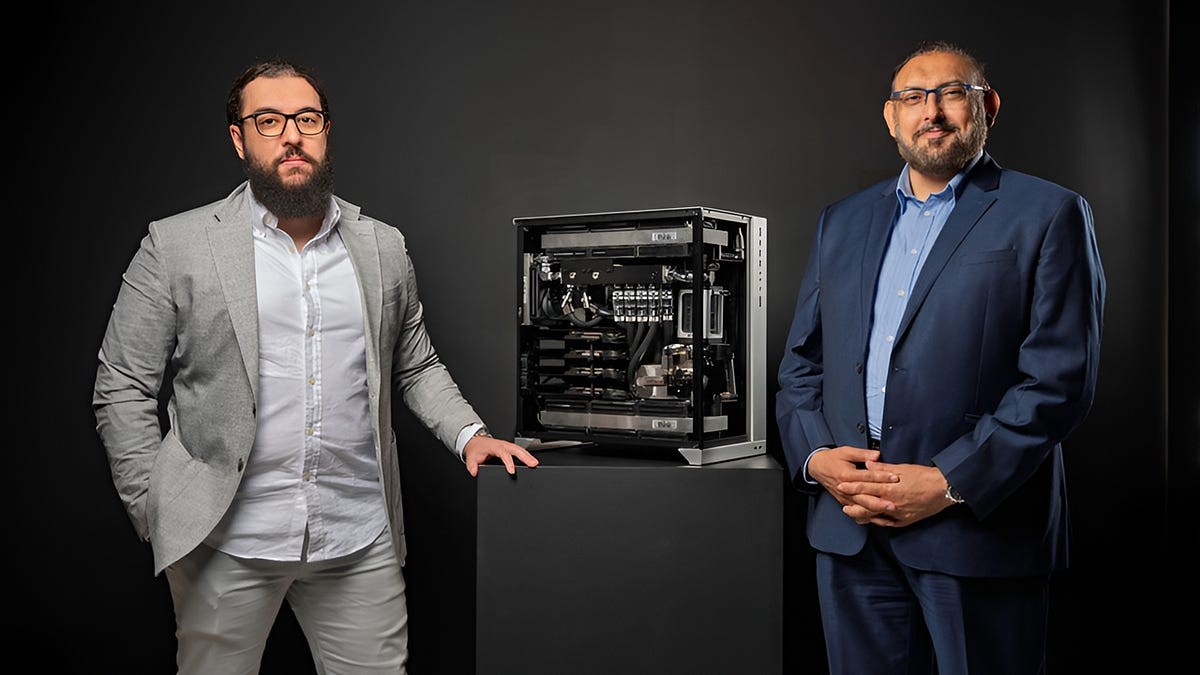
The founders know the landscape. Ahmed AlSharif cut his teeth at Meta, Sony PlayStation Europe, and EA Games. Ammar Enaya has led teams at Cisco, HPE Aruta, and Vectra AI. This isn’t an academic exercise. These are veterans of high-stress engineering.
They are already moving fast. Think holds four pending patents. They are running proofs of concept. Some have graduated to production deployments. HUMAIN, the Kingdoms national AI company, is in their orbit. Strategic partnerships are forming.
Over the next 18 months, they plan to roll out across the Gulf. They will continue building ILM as standalone software while expanding their hardware footprint inside Saudi Arabia.
Returns promised in 12 months.
Why buy instead of rent your AI infrastructure?
Let’s look at the math again. Cloud providers charge premium rates. They own the rack. They control the schedule. You get what they give you. With Think, the promise is outright ownership of the infrastructure. No recurring subscription traps for the hardware itself.
The capital expenditure hits hard upfront. Sure. But the operating expenditure drops like a stone.
Is this just a regional story? Maybe for now. They focus on GCC expansion first. They deal with specific regional concerns about data residency. But the inefficiency they target exists in every server farm in London, New York, or Singapore.
Think builds nodes that are liquid-cooled. Dense. Efficient. Their ILM software wrangles that power. Constellation finds the hidden power in office buildings.
The result? A per-million-token cost that mocks the average cloud rate. Almost tenfold savings. That is a hard number. Hard numbers attract hard capital. Hence the $8 million.
Investors smell the shift. Enterprises are waking up to the bill. Think wants to sell you a way off the treadmill.
It remains to be seen if local infrastructure can fully displace the hyperscalers. Convenience always pulls users back to the cloud. But when the savings are this drastic, inertia fights back.
Think thinks it can win that fight.