
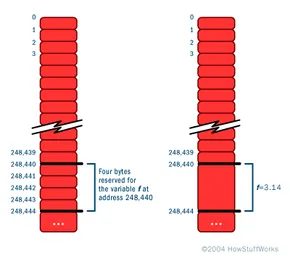
To really grasp why pointers behave the way they do, you have to stop thinking in terms of abstract variables and start visualizing the hardware. It’s a simple model, but it’s the foundation of everything from segfaults to security vulnerabilities. If you’re fuzzy on the basics of bits, bytes, and words, you should probably pause here and brush up on that first. The rest of this explanation assumes you know the difference between a byte and a bit.
Your computer has memory, or RAM (random access memory). You might have 16, 32, or 64 gigabytes of it installed. This isn’t just storage; it’s the workspace. It holds the code your CPU is currently executing and the data those programs are manipulating at this exact second. Think of RAM as a massive, linear array of bytes.
Every single byte in that array has an address. The first byte is address 0. The next is 1. Then 2, 3, and so on. These addresses function exactly like indexes in a standard programming array. Because the CPU can jump to any address instantly, it’s called “random access memory.” It doesn’t have to read sequentially. It can grab whatever it needs, whenever it needs it. When the compiler needs to store a larger data type, it just grabs a block of contiguous bytes. A standard floating-point number, for instance, usually takes up 4 contiguous bytes.
Let’s look at a global declaration in C:
To you, this is a variable named f that holds a float. To the computer, this is a command to reserve 4 specific bytes in the memory array. Let’s say the compiler assigns these bytes to memory location 248,440.
When you write:
The compiler doesn’t think “update variable f.” It thinks “load the value 3.14 into memory address 248,440.” The abstraction is thin. Under the hood, it’s all about addresses and the values sitting at those addresses.
This mechanical nature of memory leads to some nasty side effects. Consider this C code snippet:
You might expect s and t to hold 0:0, 1:1, 2:2, 3:3. And u should stay 0. Instead, the output looks like this:
Wait. What happened to t[0]? And why is u now 5?
The issue is a classic buffer overflow. Look closely at the loop condition: i<=4. The array t is declared as t[4], meaning it has indices 0, 1, 2, and 3. When i hits 4, the code writes to t[4]. That index doesn’t exist within the allocated space for t. It writes one element past the end of the array.
Because memory is contiguous, the computer places s, t, and u right next to each other in the heap or stack.
When you write past the end of an array, you don't crash immediately. You overwrite whatever is sitting in the memory slot right next to it.
In this specific case, writing to t[4] overwrites the memory location holding u (which was originally 0). But why is `u
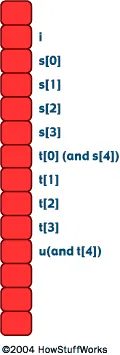
Write to s[4]. That index doesn't exist. But the computer doesn't care. It doesn't check if you are stepping on your own toes. It just calculates the address. And that address happens to land on t[0].
You think you’re writing to s. You’re actually writing to t. The system executes the command without blinking. The logic is flawed. The program corrupts data. It’s silent until it isn't.
Now try something worse.
s[1000000] = 5;
You are writing to memory your program doesn't own. The consequences depend entirely on the operating system you are running. On protected systems like UNIX, Windows NT, or Windows 98, the OS sees this violation immediately. It terminates the program. Hard stop. It protects the rest of the system from your mistake.
Older systems like Windows 3.1 or classic Mac OS don’t have that luxury. They don’t know what you’re doing. You end up overwriting code or variables in another application. The result? A glitch. A crash. Or worse, a system-wide failure that feels random but is actually the direct result of unchecked memory access.
In memory, variables like i, s, t, and u sit next to each other at specific addresses. They are neighbors. If you write past the boundary of one, you spill into the next. The computer does exactly what you said. It just doesn't care that you meant well.
The Danger of Unchecked Array Access
C and C++ do not perform range checking. They assume you know what you are doing. This means you must pay close attention to array ranges. If you read or write outside the boundaries, the behavior is faulty. Unpredictable. Dangerous.
This lack of safety is why uninitialized pointer errors are so common in C. Consider this code:
The compiler prints the value in p and the address of i. Initially, p holds garbage or zero. The address of i is usually a large number. For example, you might see:
After p = &i, p holds the address of i. Simple.
Now look at this:
This prints the value p points to. But p is uninitialized. It points to address 0 or some random bit of memory. The result is almost always a segmentation fault. A runtime error. You are trying to access memory that doesn't belong to you.
Pointers in a New Light
Once you understand these risks, pointers change. They aren't just variables. They are direct addresses to memory locations.
Take this program:
Here’s what’s happening:
How Pointers Store Memory Addresses
When you declare an integer variable like i, it takes up 4 bytes of space in RAM. A pointer, let’s call it p, also occupies 4 bytes. This size holds true for the vast majority of systems currently in circulation, where memory addresses are 32 bits long. The industry is slowly shifting toward 64-bit addressing, but for now, the 4-byte footprint is the standard.
Think of i as a house. It has a specific street address—say, 248,440. The pointer p is not the house itself. It is a piece of paper with that address written on it. When you assign p = &i, you are writing 248,440 onto that paper.
This distinction is critical for understanding how pointers work in C. The pointer doesn't hold the value of i. It holds the location where i lives. If you dereference p (using p *), you are going to that address and reading the value. In that sense, p and i * are functionally identical. They point to the same data.
Viewing the Address in Code
You can verify this behavior with a simple print statement.
printf("%d", p);
This command does not print the value of i. It prints the number written on the paper. The output is the actual memory address of i.
Why does this matter? Because it lets you pass locations rather than copies of data. You can manipulate memory directly. You can link structures together. You can manage heap memory efficiently. The pointer is a reference. The variable is the content. Confusing the two leads to bugs. Understanding the difference leads to control.
Some developers treat pointers as magic. They are not. They are just numbers. Memory addresses are integers. Treat them as such.