
We wear jewelry to look good. We use it to show off our status, express our commitment, or simply because our outfit feels incomplete without it. It is decorative. It is not “useful” in the traditional sense. Do not use diamond rings to cut vegetables. You cannot send text messages through pearl necklaces.
But that is about to change.
The line between adornment and appliance is blurring. In the near future, the necklace around your neck can also function as a GPS receiver. The watch on your wrist is probably handling your email. A pin on your lapel could potentially store your entire digital identity. This is not science fiction anymore. This is the next wave of mobile computing.
The microchip revolution
The reason for this change comes down to two things: scale and power. Computers are shrinking. They are faster and faster. Manufacturers can now pack millions of transistors onto a single microchip. These chips are small enough to fit in jewelry, but powerful enough to store large amounts of data.
This technological leap allowed the company to integrate intelligence directly into fashion. We’re moving from clunky, ugly gadgets to devices look like they belong on a body.
Researchers are already building prototypes of these digital enhancements. The list of wearable technologies is growing rapidly.
“We manufacture almost everything except the tongue ring,” says Dan Russell, senior manager of IBM’s Almaden Lab.
Russell’s team is working on the hardware side of this revolution. They make small devices that may soon adorn our bodies. Their goal is to integrate information technology so small that you hardly notice you’re using it.
The end of the desktop?
This trend represents more than just a new fashion. It is the beginning of the disassembly of personal computers into smaller parts.
The end of large desktop towers is near. Laptops are constantly evolving. PDAs are on the decline. The rest are small devices. They spread to our clothes, our bodies and our environment. Computing will become ubiquitous. It’s everywhere. you carry it with you. You put it in your hand.
This shift is changing the way we communicate. It changes the way we access information. It changes the way we interact with the world. The device in your pocket is no longer your only user interface. This is just one of many.
Why it matters to you
You might think this is only for technology enthusiasts. This is not true. This technology is designed to make your everyday life easier. Imagine you’re walking down the street and your smart ring shows you directions. Imagine being able to check your calendar without taking out your phone. Imagine being able to identify the song playing in a coffee shop with just a tap on your earlobe.
These are not distant dreams. These are the results of ongoing research into digital jewelry. Companies like IBM are leading the charge. They are looking for ways to make these devices functional, stylish, and easy to use.
It’s not a question of whether the technology will materialize. It is when. And how much do you want to digitize yourself?
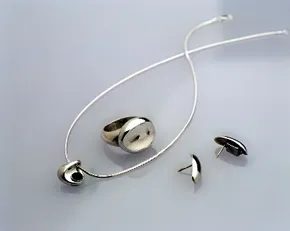
The idea of a smartphone as a single rectangular slab is getting old. Communication tools can eventually be broken down into a series of digital accessories instead of carrying around one bulky device. This is not science fiction. This is a working prototype developed by IBM that redesigns the mobile phone by breaking it down into its core components and distributing them into everyday objects like jewelry.
The goal is to create a simple but innovative product: an no fixed form mobile phone. By decentralizing hardware, IBM aims to create a system where each part has a specific function and works together to replicate the functionality of a standard mobile device.
The Anatomy of a Dissolving Phone
To understand how this works, you need to understand what is actually inside in a typical phone. This is a collection of different parts.
- microphone
- Receiver (speaker)
- touchpad or keyboard
- Screen
- circuit board
-antenna - battery
IBM’s approach takes these elements and assigns them to various wearable devices. The vision is for these components to communicate wirelessly (perhaps using Bluetooth technology) to create a seamless user experience. You aren’t wearing a phone; The parts you use are the parts it is made of.
Components and their roles
This prototype is based on certain “computerized jewelry”, each of which has its own role in the communication chain.
Earrings as receiver
Sound output is handled by speakers embedded directly into the earrings. These jewelry emit sound when you receive a call or play media, so you don’t have to hold the device to your ear.
Use your necklace as a microphone
Input is controlled by a necklace with a built-in microphone. You speak into this piece and make your voice heard. It acts as the primary input device and replaces the traditional telephone microphone.
Ring as the Interface Indicator
Perhaps the most interesting component is the ring with light emitting diodes (LEDs). This acts as a visual notification system. The LED light flashes to indicate an incoming call, but the system is customizable. You can program the ring to flash different colors to identify a specific caller or to indicate the urgency of the message. It’s basically a “magic decoder ring” for your digital life, giving you information at a glance without having to look at a screen.
Bracelet as display and control center
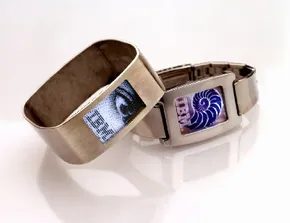
The wristband has a VGA screen. This screen has many uses. It acts as a caller ID and displays the caller’s name and number. In addition, it has a built-in user interface for calling and controlling the phone.
Eliminating the Keypad
One of the biggest changes to this model is the removal of the physical keyboard. Why type out a number when you can use speech recognition? Speech recognition software, already common in modern cell phones, will handle the dialing process, IBM said. Just say the name of the person you want to contact and the system connects you.
This reduces the need for complex input mechanisms in the jewelry itself. The bracelet might still have controls, but relying on voice commands minimizes the need for buttons and touchpads on each component.
The Power Problem
All these wireless components require energy. IBM is currently developing small, rechargeable batteries that can power distributed systems. The challenge is how to keep these individual parts charged without a central hub that dominates your body shape

The noise of an overflowing inbox is quieter and perhaps more noticeable. Digital jewelry is no longer just about answering the phone. It also works with email management.
Imagine having that same ring that vibrates when you don’t answer a call and blinks silently to alert you of a growing number of unread messages. This is more than just an notification. It’s a matter of context. Lights can signal an urgency. A slow pulse of regular updates. Use rapid strobe for anything that needs immediate attention. No need to look at the screen to receive the signal. You stay in the flow.
IBM is already working on this. They are designing a ring that aims to change the way we interact with computers. The goal is a simpler interaction. Reduces friction. More focus.
Beyond the Inbox
我们大多数人都会花几个小时清理电子邮件。 这是一项永无止境的数字苦差事。 数字珠宝提供了一种不同的方法。 您不会打开笔记本电脑来检查邮件量,而是会感受到警报。 你决定是否重要。 如果没有,您可以忽略它。 如果是的话,你就处理它。
这改变了权力动态。 您的设备为您服务。 他们不会不断地要求你的关注。 环变成过滤器。 它将信号与噪声分开。
The IBM Interface
The IBM ring mentioned in the earlier reports is only a prototype. Not available yet. But this is an indication of where the industry is going. The idea is intuitive control. Wearable technology that responds to your presence and actions. There is no keyboard. There is no touch screen. Just gesture and touch.
This might mean sliding your finger through the air and scrolling through emails. Or click the ring to answer. The interface will be hidden. Focus on content. Not the device.
Why It Matters
The screen time is at an all-time high. We addicted to checking of notifications. Digital jewelry breaks this cycle. It brings awareness back to your body. You feel the alert. You respond. Then you move on.
The ring doesn’t replace a computer. It complements it. It handles the basics. Complex tasks remain on the screen. However, you can choose when to look. That’s the real change. Autonomy. control. Less distraction.
The future of computing is about more than faster processors. It’s about better interaction. Smoother. More human. The IBM ring is a step in this direction. One flash at a time.
Mouse and monitor are the two basic pillars of personal computing. Today, they are as ubiquitous as the television in your living room. However, this familiar environment may not last the next decade. At least not in its current form.
Companies like IBM and Charmed Technology are actively working to disrupt the desktop paradigm. They don’t just adjust the interface. They build completely new ways of working with data. result? head mounted display. Screen worn on wrist. An input device that fits your finger.
How IBM’s TrackPoint Ring changes input
IBM solves the input problem with a new idea: shrinking the mouse to the size of a ring. This is not science fiction. This is a continuation of the TrackPoint technology. If you’ve ever used a ThinkPad laptop, you’re probably familiar with this. This is the small red block embedded between the G, H, and B keys on the keyboard.
Now researchers are applying this precise pointing technique to jewelry. The prototype looks like a black pearl ring. Above it is a small black ball. Roll it with your thumb. Just like the keyboard nub. The cursor moves across the screen without touching the physical mouse pad.
This is not just a trick. It solves a critical spatial problem. As monitors get smaller, traditional mice become unusable.
Next steps in screen development
The real change is about more than inputs. It’s inside the screen itself. We are moving towards ubiquitous computing. Your monitor is no longer attached to the table. It doesn’t hang on the wall.
On the contrary, they will be worn. It’s like sunglasses. Or a bracelet.
Wearable displays face one major hurdle: readability. How do you read complex information on a screen the size of a watch face? IBM and other companies are racing to solve this problem. High-resolution pixels must be packed into a small format. It has to be energy efficient so it doesn’t drain the battery in an hour.
When you put the screen on, the user interface should adapt. Text needs to scale. Icons should be tappable on glass, not just a finger swipe.
Interesting technology communicator
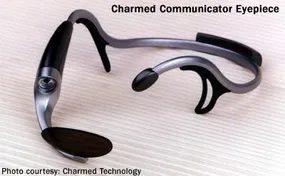
Although IBM is still in the development phase, Charmed Technology is already marketing its vision. They call it the Charmed Communicator. This is a wearable, wireless broadband Internet device. It looks very futuristic. It feels like digital jewelry.
The device is centered around the eyepiece screen. But it’s more than just a screen. This is the perfect computer. You can control it with your voice. Use a pen. Or handheld keypad.
The company claims it can enter the mainstream market in late 2001 or early 2002. That timeline feels aggressive now. But the hardware is there.
Communicator does more than just display information. It plays MP3s. It runs video. You can make phone calls just like you would on a mobile phone. Before “fusion” became the buzzword of the decade, it was a convergence device.
Under the hood, it runs Nanix, a Linux-based operating system. At that time, Linux was still very much a niche market. Now it’s taking over the world. Nanix is betting that open source code can run on small wearable devices.
为什么这对用户很重要
我们认为桌面是理所当然的。 我们不知道它们占据了多少空间。 或者他们需要多少关注。
可穿戴技术改变了这一点。 它让你从椅子上解放出来

We are drowning in credentials. Every door, every app, every secure login requires a password that you rarely remember. It is exhausting. Enter the Java Ring, a device that promises to end the tyranny of the keyboard. Developed by Dallas Semiconductor, this is more than just jewelry. This is a wearable computer.
The concept gained traction at the JavaOne conference and evolved from speculative technology to a pilot project at the Celebration School, a high-tech K-12 campus near Orlando, Florida. Schools have become the testing ground of the future, where your identity is determined not by what you enter, but by what you wear.
The hardware behind the jewelry
At first glance, the Java Ring looks like a simple stainless steel band. The diameter is 16 mm. However, there is an iButton processor inside the band. This is no ordinary chip. A million transistors are packed into a space smaller than a grain of sand.
The technical data is surprisingly robust for a ring. It has 134K RAM and 32K ROM. More importantly, it includes a real-time clock and a Java Virtual Machine (JVM). JVM is a bridge. Interprets Java applets (small independent programs) and compiles their commands for the host system.
To work, the ring snaps onto a reader called a blue dot receptor. The user presses the signet of the ring against the receptor. This physical connection triggers the applet stored in the iButton. The host system reads and executes the instructions. No typing. No remembering. Just proximity and pressure.
Life at Celebration School
The Celebration School pilot demonstrates the practical power of this technology. Rings aren’t just for show. They were multifunctional tools embedded in daily school life.
Students use Java Ring:
– Store electronic cash for cafeteria purchases.
– Automatically open classroom and office doors.
– Mark attendance immediately.
– Access personal medical records.
– Check out the books in the library.
All this information is lived on the ring itself. iButton acts as a secure portable hard drive that protects students’ identities. If your school needs to update its system, please update the host application. The ring’s applets handled the rest.
Outside the classroom
This is an early look at the next evolution of mobile computing. Laptops are big. PDAs were awkward. The Java Ring proposes an alternative route for moving digital components from your desktop to your body.
The idea is Digital Jewelry. Technology designed to complement, not replace, personal computers. It adapts to the human shape and becomes natural, like a wedding ring. The possibilities extend far beyond the school walls. The same technology could eventually start your car or authenticate your banking transactions.
The Legacy of the Ring
Java Ring never became the standard we see today. Smartphones and NFC chips absorbed much of this functionality. But the vision remains. Now we can open our doors and make payments with our phones, watches and even our cars. The “Blue Dot” reader has been replaced by a wireless signal, but the core idea remains.
Your device is your key. Your identity is your password.
The transition from typing to touch is messy. This went on for several years. But Java Ring shows us that the safest and most convenient interface is the one you already have.
For those more broadly interested in wearable technology, the field has grown explosively since then. We are currently looking at computerized clothing that monitors vital signs, electronic ink that mimics paper, and Power Paper that generates energy through movement. This ring is just the beginning of a body-centric digital revolution.
Resources such as iButton: Celebration School Photo Gallery and various Java Ring fact sheets remain in the archives as historical markers of a time when engineers believed the future of computing was on our fingers.
Now this is a strange thought. The processor in the ring. It feels like something out of science fiction. Or maybe this is just science fiction waiting to happen again. The line between the two is thinner than we think.