Data centers are exploding. They pop up like weeds. Fast. And nobody is happy.
The US is seeing a rush. Massive facilities designed for AI tools are rising everywhere. Cities fight back. States pass laws to slow the construction. The friction is real. It’s about land, water, and the sheer amount of power these machines drink.
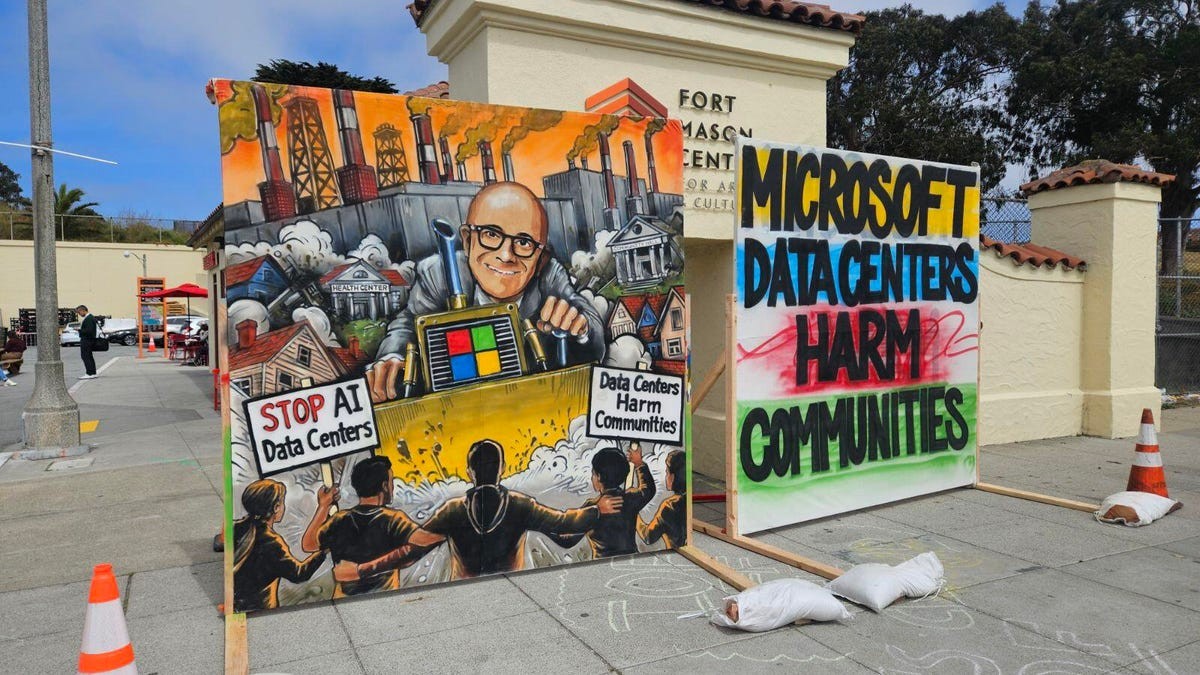
While Microsoft held its Build conference in San Francisco last week, the air was thick with tension. Inside, suits talked code. Outside, protesters like Amy Herman stood guard at the entrance of Fort Mason. She handed out leaflets. Not just noise. A counter-narrative.
Herman wasn’t against technology.
“It’s more of an opposing viewpoint,” she said. “We’re not against monetization of innovation.”
Her point is simpler. Resources are limited. Big tech acts like they own them all. They chase advancement but dodge climate accountability. The ripple effects? They’re felt far beyond Silicon Valley. Across the whole country.
Microsoft? They claimed they “respect the right to peaceful protest.”
Nice slogan.
But inside that keynote on Tuesday, CEO Satya Nadella tried something different. He promised change. Or at least, he promised to ask nicely from now on. Community permission. That was the new buzzword.
How would they earn it? Better cooling. Less water. No spikes in local electricity prices. Taxes that fund hospitals, schools, libraries. Investments in local AI training. It’s a lot to promise.
Nadella called this buildout “extraordinary” on a podcast. Live. He sounded earnest. Maybe desperate for legitimacy.
“It has to be real.”
He meant the benefits. Locals need to see them. No energy price hikes. Maybe even lower costs due to grid upgrades. Water replenishment. It’s not just PR spin, he argues. It’s survival for the industry.
“All this has to be real. If not, you won’t have permission.”
Simple logic. Or so it sounds.
Outside, Herman wasn’t convinced. She pointed to rural areas. Electricity prices there have skyrocketed since data centers arrived. Families choose between meds and lights. That’s the “ripple effect.”
Microsoft claims they’re listening. They say people should ask hard questions. Skepticism is good for the industry? Sure, when you control the narrative.
Let’s look at the scale.
Microsoft has over 500 data centers. 80 regions. The growth in the last 18 months outpaced their first decade of Azure cloud service. This isn’t just a US issue. Australia, Europe, Africa, South America—they’re everywhere.
Then there’s Fairwater. Nadella calls it an “AI super factory.” His first of many.
Live in April. Ahead of schedule. He bragged about it on X. Called it the most powerful in the world.
The tech is impressive, sure.
- Training: Preparing models.
- Inference: Using those models.
- Agent runtime: Keeping them active.
Nadella emphasized the power delivery. Hundreds of kilowatts per row. Minimizing conversion loss. It’s engineering porn.
But what about water?
He touted a new cooling system for Fairwater. Filled once. Then… nothing?
“The daily water usage over a year is roughly what a single restaurant uses.”
Zero water consumption after the initial fill? It sounds too good.
Harvard’s Ari Peskoe puts it bluntly: some under-construction centers will use more energy than large cities.
Let that sink in. A city versus a building.
Fairwater runs on ~140kW per rack. ~1.3 megawatts per row. Typical US home? ~1.2kW total.
The math is brutal.
Nadella repeated his principles during the keynote. Don’t raise prices. Replenish water. Create jobs. Pay taxes. Invest locally.
“Only when we live up to this… do we earn the permission.”
Permission to build. Permission to innovate.
I asked Herman if she believed them. Did she buy into the community outreach?
Doubt. Always doubt.
She wanted a cooperative model. Democratic values in business ops.
“I haven’t seen that internally,” she said.
If Microsoft doesn’t trust itself with democratic values inside the building, why would she trust them with her water bill outside?
The protest continues. The centers keep rising. The gap between the promise and the pavement widens.