
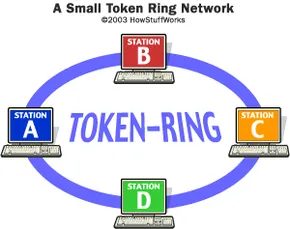
Ethernet is winning the LAN wars. It’s everywhere. But it was not always the undisputed king. Before random access protocols became commonplace, IBM introduced Token Ring, a system designed for order, not chaos. Ethernet nodes wait for silence before shouting, and Token Ring nodes wait for a pass.
The architecture is deceptively simple. Nodes are located in logical rings. Data moves in one direction. When a frame completes the circuit, the source station discards the frame. This is not just a theory. This is a specific standard that has defined business networks for many years.
Token Mechanism
The entire system revolves around one object: the token. This is a special frame that acts as a permission slip. Without it, you cannot transmit.
The process is rigorous. Tokens circulate constantly. When a station has data to send, it captures the token. It doesn’t ask. They don’t wait. It replaces the token frame with a data-carrying frame. This new frame encircles the network.
When the frame is returned to the sender, the station performs two actions. It removes the data. It creates a new token. Pass this token to the next node.
This cycle ensures fairness. No station can hog the line. every station gets a turn because the node only sends one data frame before transmitting the token. There are no collisions. There is no “career meaning.” There is no listening for gaps in the signal. The presence of a token guarantees uninterrupted transmission.
Speeds and limits
Token Ring networks typically operate at 4 Mbps or 16 Mbps. For that time, these speeds were impressive. It provides deterministic access that allows latency to be predicted with reasonable accuracy. This makes it attractive in environments where stability is more important than pure throughput.
However, the hardware is complex. Although the physical topology typically looks like a star, the logical topology is still a ring. This adds configuration that most network administrators prefer to avoid.
The Rise and Fall of FDDI
Although Token Ring is a standard for copper cabling, a faster alternative to fiber-optic distributed data interface is Fiber Distributed Data Interface (FDDI). It used a dual-ring architecture. The two rings pass tokens in opposite directions. This provides redundancy. If one ring failed, the network can reconfigure.
FDDI offers data transfer speeds of 100 Mbps. In the early 1990s, that was blazing fast. It is popular in corporate and university backbone networks. It handled heavy traffic with ease.
Why FDDI disappeared
FDDI didn’t die because it was a bad technology. It died because Ethernet got better and cheaper. The advent of 100-Mbps Ethernet changed the landscape. Suddenly you can achieve FDDI speeds without complicated double rings or special fiber optic connectors.
Ethernet is easy to manage. It was cheaper to deploy. It’s everywhere. When Ethernet speeds exceeded 1 Gbps, the FDDI niche disappeared. Its popularity gradually waned and was replaced by a technology that was good enough and infinitely more flexible.
References to Token Ring can now be found in legacy systems and museum collections. These concepts exist in modern protocols that prioritize fairness and deterministic access. But there is no physical ring